In an earlier post and against my definition of démontage, I broached the question of blank frames in bandes dessinées (BD) in relation to how our eyes might follow a pre-set pattern across a page of blank frames. Do influences such as narrative, psychosomatic causes (vision-brain-body prompts), habitual expectations and the meaning of apparently blank signs impose necessary patterns, sensations and readings on the reception of the page?
I raised this question in relation to speculation and observation in metaphysics, because possible answers depend on how we observe BD, what we conclude from that exploration, and which metaphysical presuppositions we bring to observation and to the drawing of conclusions. What we think BD can do depends on how we look at it and the assumptions we make prior to observation. There is no neutral ‘looking’.
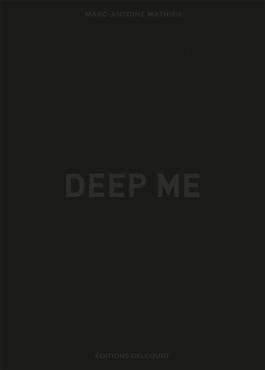
The opening panel is the front cover from Marc-Antoine Mathieu’s Deep Me. His BD are exceptional and well worth enjoying, if you haven’t encountered him before. The series Julius Corentin Acquefacques is a thrilling experiment in the potential of bande dessinée, equivalent to experimental film and novel inventions in painting.
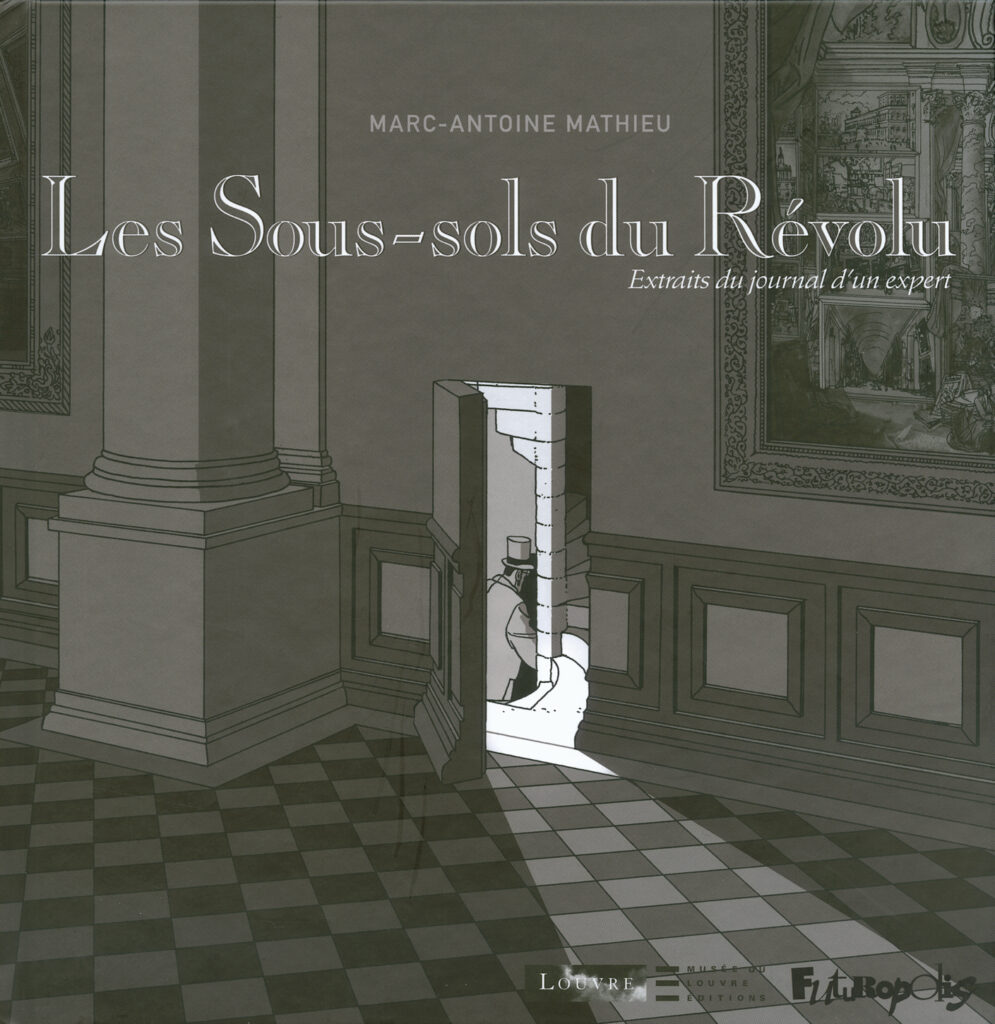
Mathieu is highly knowledgeable and funny about art and philosophy, inventive in that understanding too; for instance, in his dizzying book about the Louvre with an extraordinary example of mise-en-abyme (a frequent theme for Mathieu) and experiments on scale and perspective in bande dessinée (typical of his technique).
With its contribution to political and existential ideas Deep Me is much more than a stylistic exercise. The BD makes wide and inventive use of blank panels – in this case black ones, though in its sister volume Deep It, they are white. They are a feature of Mathieu’s art and appear throughout his work in an exceptionally knowing and self-referential manner that was once (mistakenly) taken to be the signature of postmodern art – the creativity and genre redefining quality of Mathieu’s art have everything of what was once called modern art.
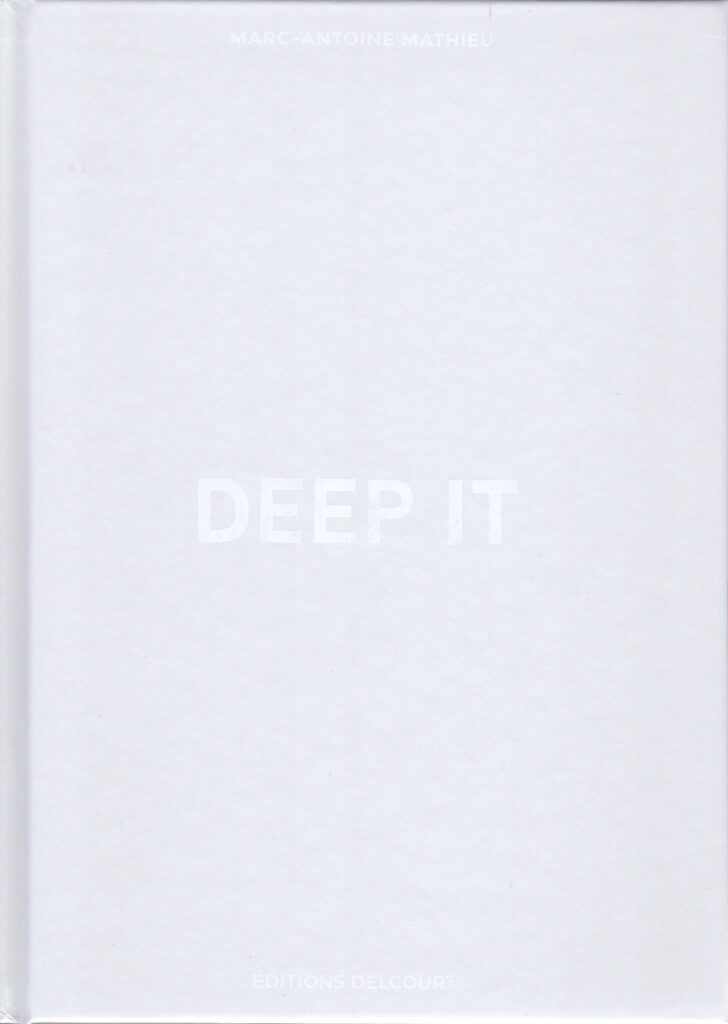
In addition to his exploration of the medium of BD, Mathieu is a philosophical writer and BD creator. Among many other thought-provoking themes, Deep Me is an investigation of the nature of consciousness, in line with contemporary cognitive science and debates in philosophy of mind such as the possibility of post-anthropic thought.
The experimentation with types of blank black panels serves to convey a locked in mind-in-a-machine (like a brain in a vat or stored in a computer) or, depending on a different interpretation, a form of self-aware artificial intelligence. In both cases, the storyline follows minds embroiled in an attempt to continue human intelligence after extinction.
If you follow the links through the above image from Deep Me or the BD titles, you will get to the Delcourt pages advertising the works. The panels and pages give a good sense of Mathieu’s inventive use of blank frames and pages. It is wise to be cautious with these digital renderings, since the printed pages are much more visually subtle and nuanced than the digital ones.
The printers of both volumes, but in particular the ‘black’ album, have done an extraordinary job in capturing different types of textured blank, as achieved by Mathieu’s outstanding skills in pen and black ink. Thanks to artist and printer, the sheet becomes tactile for the eye, with the kind of shades, spaces and contours found in painting, such as Fontana’s art of slashes, where neither the slash nor the cut surface can be said to be uniform since they have edges, gradients, shapes, distances and shades.

As an aside, the indents and contours of painting and the surfaces of a carefully prepared physical print demonstrate an aesthetic advantage for printed works over digital ones. Digitisation has already taken over short comics due to the shift to online newspapers and sites. It will take on a greater role in BD albums publication, given cost and distribution advantages in saturated markets.
There are advantages to this move to a medium introducing motion and interaction (when at its best). However, the loss of physical features, in particular in relation to bodily movements, touch and light reflection, reacting to paper qualities and colouration, leads to a speeding up of reception (to flat and transient images) and external control over it (in frame succession and limited ranges of interactions) resulting in a curtailment of sensual experimentation. It is much harder to linger in the digital.
Referencing the greater purity of a digital screen, it could be objected that once a work is textured, like the above Fontana, it is not a true blank. Physical contrasts and differences imply at least two, but in fact many, shades and variations distancing a work from the true blank.
The necessity of this remove from the abstract idea of absolute featureless purity is my point. There is no such thing as a pure blank. Every blank is an event of transmission with necessary interference. The black or white page is received, passively and actively, in such a way that each page is recreated as motion through textures, contours and light, beyond any single sense such as vision.
Mathieu’s use of textured blanks resists the classic use of blanks in bande dessinée to indicate temporary or permanent visual impairment. Even if the blank is designed to convey this lack, as in Charlie’s father’s blindness in Carson and Blair’s beautiful and sad graphic novel The Hunting Accident, the blank is not limited to this signification. On the contrary, each communication of blindness in the novel is much more dense and complex, carrying the narrative in many unexpected and shocking directions (as shown in Danielle L. Eisenman’s perceptive review).
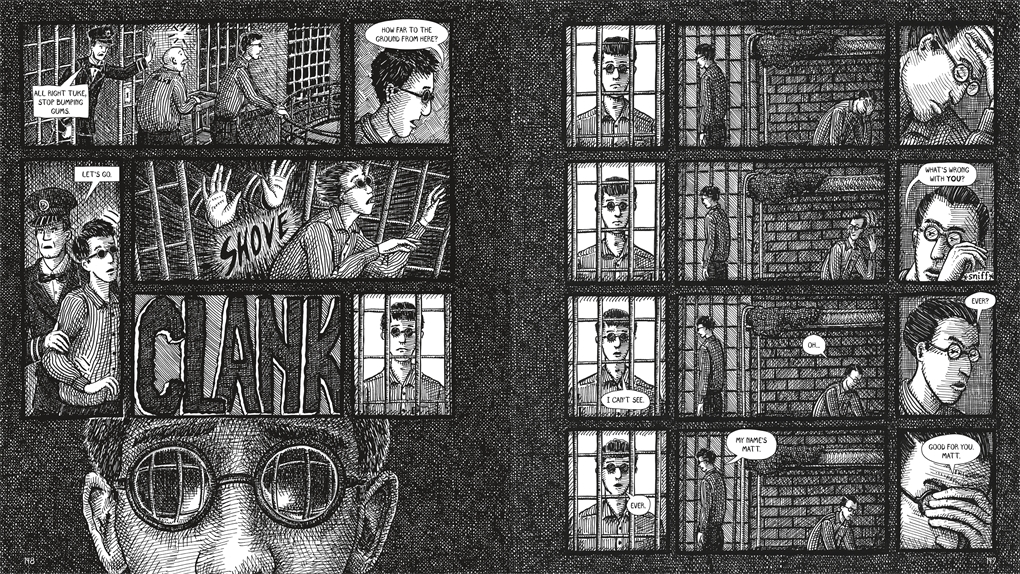
In prison, Charlie’s father learns to detect features beyond any simple blankness, such that his world is not defined by lack of vision – its limitations are moral (in the extreme) and affective rather than sense-based. Blindness is not the key to the novel, but rather a portal to other emotional and creative, poetic, struggles with desire, deceit and love.
Like shifting landscapes, we feel through Fontana’s contours and we explore Mathieu’s black and white enigmatic blocks. He makes wonderful use of sand and dunes in Volume 6 of the Aquefacques series, Le décalage, his deepest play on time, space, printing and existentialist themes from Pascal, Sartre, Camus, Dostoyevsky, Becket. Nietzsche and Kafka (a reverse homophone of Aquefacques). In addition, the volume has many unmissable dry philosophical jokes; an hit parade of paradoxical and absurdist remarks, arguments and scenes.
Mathieu’s imagining of the page as a shifting dune made up of tiny grains that turn out to be random chains of 26 letters is a clue to understanding the nature of a blank page or frame. Pure blanks are always an intellectual abstraction from a body of infinite potential movements, sensations, senses and creations. They are invitations to explore and invent in multiple ways and directions, free of any fixed signification, such a blindness, disorientation, oblivion or hiatus.
The empty frame is not an abstract experienced as a pure form. It is closer to our confusion and effort in a whiteout or thick fog out than to a conceptual idea of purity.

This event-like quality of the blank is a feature of Mathieu’s art in his two Deep albums. In the black album, the locked-in consciousness populates the blank with questions and hypotheses, with sensations and moods, with voices and messages.
In the white album, an artificial mind transforms blank whiteness into noise, meaning, questioning, debate, knowledge and existential crises. For both, as this interaction takes place, the purity of each blank takes on much more varied qualities.
None of this justifies my claim about the infinite potential of a blank. It could be objected that each question, argument, reaction or crisis in the albums is part of a narrative arc or action-based series. Narrative and action would then take precedence over open and infinite potential. The blank is subject to them, rather than the opposite.
A preliminary response to this objection has two stages. First, it is to acknowledge the importance of narrative and action. Of course, bandes dessinées unfold thanks to storylines and actions. Second, though, this unfolding is neither sufficient nor necessary. There is always potential for more and always freedom from established narrative and action.
I don’t deny the role and importance of narrative and the ordered succession of frames in BD. For instance, the jaded tales told by Chabouté in his Fables amères volumes depend on the punchlines ending each fable. Without the ending the lesson and bitter realisation about aspects of French society would be lost. Even more than humour’s dependence on punchlines, series of frames in a fable lead to and depend upon that last turnaround.
My point is quite different and comes from the observation and metaphysical speculation I raised at the beginning on this piece. Despite the importance of narrative chains, BD retain a freedom to be redirected and taken differently at any frame and within any frame. This is true of any reception of a work, across all artforms, but it defines bande dessinée as the art most open to démontage: the unpicking and reinvention of its directions, sensations and meaning.
In a distillation of many of his techniques, playful tricks, jokes on scale and love of visual paradox and illusions, Mathieu’s bande dessinée Sens exploits démontage through a structuralist experiment on the aleatory nature of a sign. Each frame redirects earlier ones and each series of pages or frames can be read in new directions, forward and back, up and down. All of this is achieved through a deconstruction of the arrow sign. The indicator of direction is vulnerable to endless deflections and turnarounds.
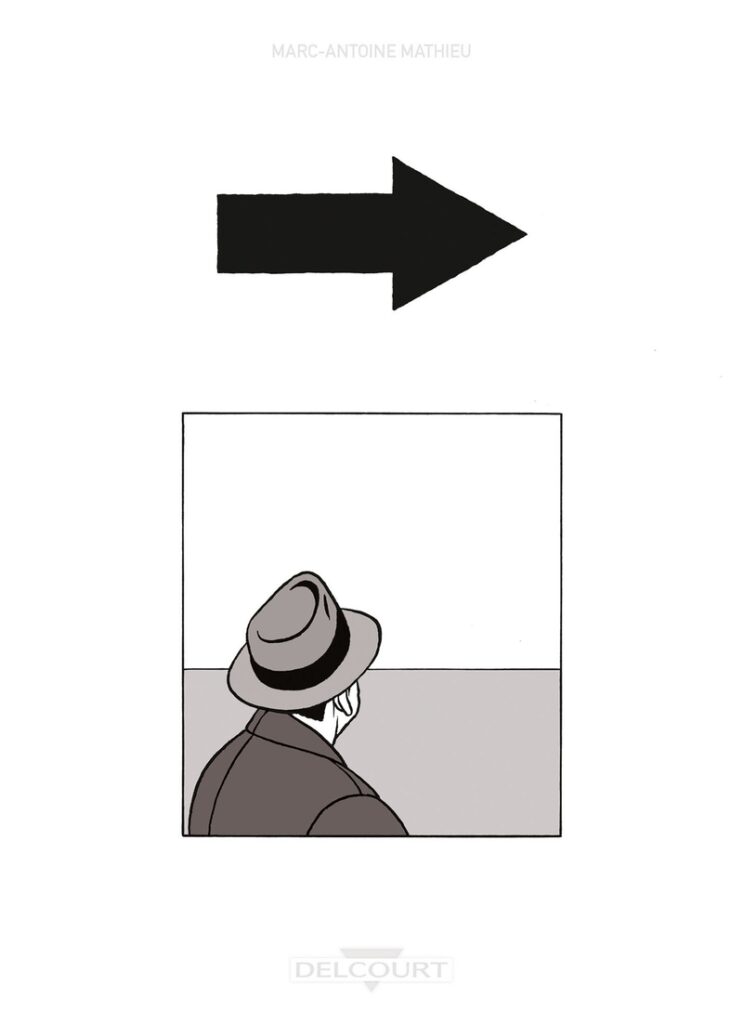
For publicity, sales and cataloguing reasons, the album has been given a one word name, Sens. The BD itself has no such name, as shown on the cover above. Mathieu is not only deconstructing the indicative function of the arrow, but also the priority of sense (with its two-fold signification in French as direction and meaning). Meaning is erased and recreated in the album’s auto-démontage.
In the title to this post I added scale and value to the idea of direction, claiming that together they form a triangular problem. The argument is that démontage is not only about which way we work through the frames of a BD, but rather that within each frame and across them we can focus in and out on different things such that relations of magnitude are undone. This change of scale is a favourite method used by Mathieu to drive his bande dessinée in unexpected ways.
Changes in scale and direction also affect value: the implied worth, relations and hierarchies between different ideas and things in the albums, frames and storylines. This follows directly from the breaking up and reassembly of narratives. The story and its lessons change. It also follows from the creation of new relations through new scales and associations. All the contents are shaken up and fall differently. This is the problem for any reception of a bande dessinée in its openness to démontage. Which way? Focusing on which scales? Which values to encourage and which to silence?
The Julius Corentin Acquefacques series is therefore a reflection on the essential qualities of bande dessinée. It is a formal experimentation on démontage, on the potential for BD to change when it is received through, in this case, the introduction of spatio-temporal puzzles, the pushing of the boundaries of the genre as narrative driven, and the investigation of philosophical paradoxes and aesthetic transformations.
The series most obvious but nonetheless exhilarating moments are physical and visual tricks, such as cut out blanks, spirals, mise en abyme, page reversals, subtly varied repetitions, plays on perspective and scale and, towards the end of the series, experiments with 3D, page sizing, and folding. All of these loosen the links between frames, the lines of narrative and the well-ordered nature of any given frame.
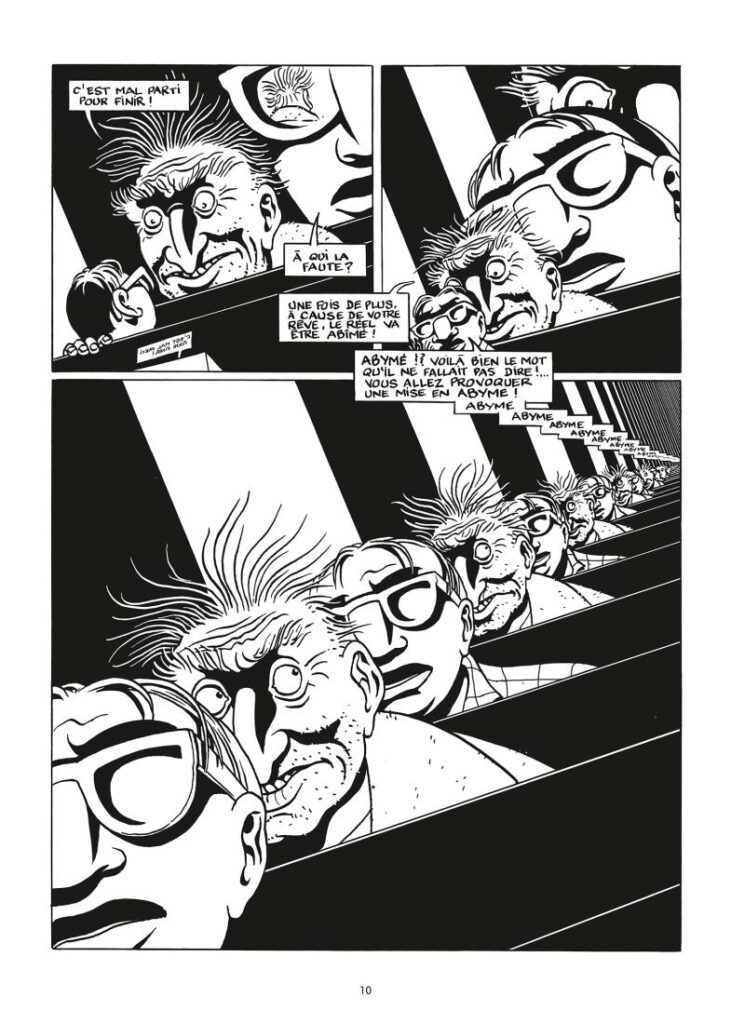
Mathieu’s work will be commented on for BD theory for many years to come – its revolutionary aspect for the form of bandes dessinées has already been noted and discussed as a metaphysics of the genre.
His work on the blank frame puts a well-known structuralist problem at the heart of BD. What does a blank frame mean? Does it signify everything, as an empty space anything can fill or refer to? Or does it mean nothing, as a meaningless signifier shorn of any referent?
In response to these questions, I have argued in an earlier post, that any blank frame – in fact any frame – is determined by an undecided vector field. There is a vectoral pull caused by narrative and by different types of physical momentum such as eye movement (scanning), conditioned reflexes (peering closer) and instinctive reactions (to duck or shy away).
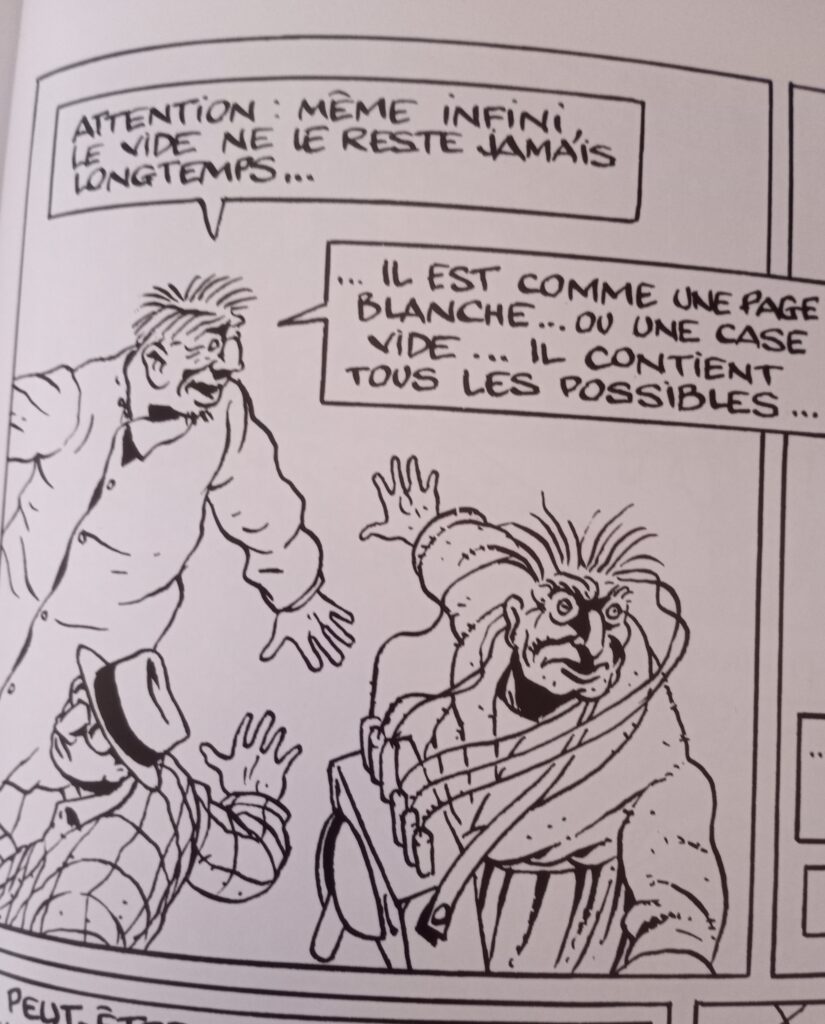
However, on reception, the field can be deflected such that at first unseen vectors take the lead and create the frame and series of frames differently. Narrative and action are forces within any frame, including a blank one, but they are neither necessary nor sufficient, because the blank frame demonstrates that every frame can go in any direction: “It’s like a blank page… or an empty frame… it contains every possibility…” (Marc-Antoine Mathieu, L’hyperrêve, Paris: Delcourt, 2020, p 31, my translation from original image below)